
Why the RCD keeps tripping in Maltese homes
The 30 mA RCD in your distribution board is required by law and is doing its job when it trips. This article explains the Malta-specific causes — inverter loads, ageing water-heater elements, humidity, shared block earths and high earth resistance — and when replacing a Type AC device with a Type A is the actual fix.
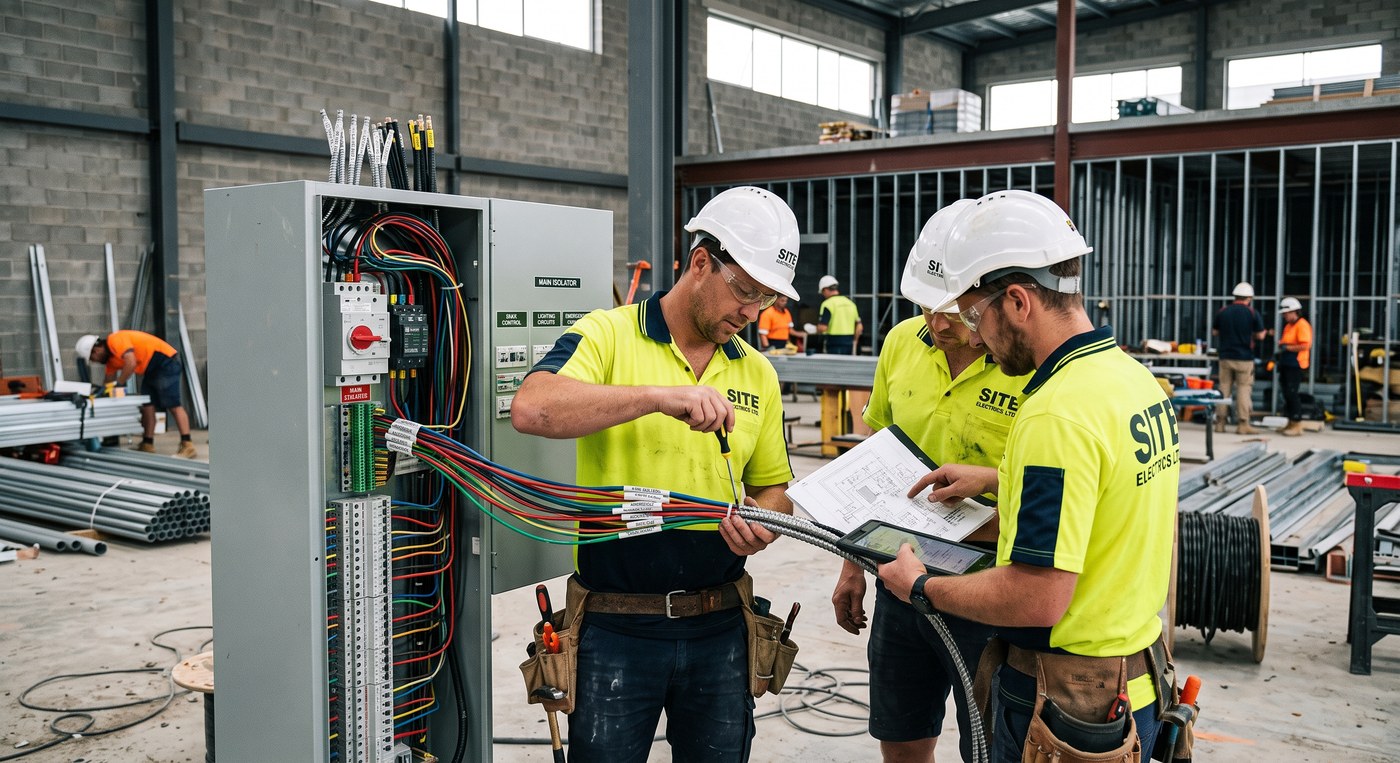
What the regulations actually require
The Electrical Installations Regulations (S.L. 545.24) set out the devices that must sit in a consumer's distribution board and the order they sit in: the main breaker, over-voltage protection, then a 30 mA residual current device. Enemalta repeats the same requirement in its consumer-facing safety guidance. Regulation 22 deals with earthing, and regulation 16 provides for periodic testing of the installation.
This matters for arrivals from the UK and elsewhere because the framework is Maltese. The document that governs your board is S.L. 545.24 and the REWS regulations booklet, not BS 7671, and the authorising body is the Maltese regulator rather than NICEIC or NAPIT. The devices are broadly familiar; the paperwork, the supply arrangement and the earthing practice are not.
The other difference that shapes everything below: the normal domestic supply here is single-phase 40 A. Where a UK board might split loads across several RCBOs, a great many Maltese boards run the whole dwelling through one 30 mA RCD. Every circuit's small natural leakage passes through that one device. Add enough electronics and one more deteriorating appliance tips the total over the threshold — and the whole flat goes dark, which makes the fault look dramatic when it is really cumulative.
What the RCD is measuring
An RCD compares what goes out on the line with what comes back on the neutral. If more than about 30 mA fails to return, it assumes that current has found another path — through earth, through water, or through a person — and disconnects. It is not an overload device and it does not care how many amps you are drawing.
So a tripping RCD is not a faulty RCD by default. It is a report. The job is to work out what is leaking.
Type AC, Type A, Type F, Type B
The REWS regulations booklet sets out the RCD types — AC, A, F and B — and addresses inverter loads. This is the single most common reason an otherwise sound Maltese installation trips for no visible cause.
A Type AC device is designed for sinusoidal alternating residual current. A great deal of modern equipment does not leak that way. Electronics with switched-mode power supplies, inverter air conditioners, inverter washing machines and fridges, LED drivers, EV charging equipment and PV inverters can produce residual currents with a DC or higher-frequency component. A Type AC device faced with that kind of leakage can behave unpredictably: it may trip at an unhelpful moment, or — the more serious failure mode — it may be blinded and fail to trip when it should.
Type A covers pulsating DC residual current. Type F extends that to the mixed-frequency currents typical of single-phase inverter-driven appliances. Type B covers smooth DC and is the territory of three-phase and specific PV or charging arrangements.
The practical Malta pattern: a board fitted years ago with a Type AC device, a household that has since added split units, an inverter and a dozen chargers, and an intermittent trip nobody can reproduce. Determining which type the installation now needs is a job for the person who tests it against the booklet, because the answer depends on what is actually connected.
Ageing water-heater elements
Immersion elements in storage water heaters fail slowly. The element sheath develops a pinhole or absorbs moisture, and a small leakage current to earth begins — often too small to trip on its own, and often only present when the thermostat calls for heat. That is the classic "it trips at six in the morning" or "it trips when we shower" complaint. Because the leakage is heat- and moisture-dependent, it can disappear entirely for days.
A water heater is also the most likely single appliance to be sitting on a roof or in an exposed shaft, which brings it into the next category.
Humidity, salt and exposure
Maltese conditions are hard on installations. Roof-level equipment, external sockets, pool and terrace circuits, and anything in a damp shaft or a kitchen wall that shares a party wall with a shower all accumulate moisture in accessories and joints. Moisture across terminals is a leakage path. It behaves seasonally and after rain, which is why tripping patterns often correlate with weather rather than with appliance use.
Shell-form purchases matter here too. Where a flat was bought as a shell and finished by more than one trade over time, junctions and chases may not be documented, and finding the wet one is a testing exercise rather than an inspection.
Earthing, the 50-ohm guideline and shared earths in blocks
The REWS booklet gives a 50-ohm guideline for earth resistance and recognises that a block of apartments commonly has a common earth. The Malta Independent's overview of local electricity and water installations makes the related point that earth electrodes need maintenance — they are not fit-and-forget.
Two consequences follow. First, an electrode that has corroded, dried out or been disturbed by building work can push earth resistance above the guideline, which changes how faults develop and how protective devices behave. Second, where the earth is shared across a block, your RCD can be reacting to conditions that are not inside your flat at all: another apartment's faulty appliance, a deteriorated common electrode, or works in the common parts. This is also where condominium rules bite, since anything done to shared risers, the common earth or the common parts is not a unilateral decision by one owner. In Gozo the same investigation carries the extra practical friction that every part and every specialist trip involves the ferry.
Over- and under-voltage is a different device
Owners sometimes attribute a trip to a voltage dip. Over- and under-voltage protection is a separate device in the sequence required by the regulations, discussed both in S.L. 545.24 and in The Malata Independent's overview. If your supply is disconnecting on voltage excursions rather than leakage, that is a different diagnosis and a different device. Knowing which one operated is the first thing an electrician will ask, and it is worth looking at the board before you reset anything.
What you can usefully observe — and where to stop
Before the visit, note: what time it trips, what was running, whether it is weather-related, whether it resets immediately or only after some minutes, and which device in the board actually moved. That information shortens a fault-finding visit.
What not to do: open the board, tape a device closed, replace a 30 mA RCD with a plain breaker, or fit a different RCD type bought online. All of those either remove required protection or install a device whose suitability has not been established by testing. The installation has to remain compliant with S.L. 545.24, and an RCD selection made without measuring the leakage and the earth is a guess dressed up as a repair.
What it costs
Check Your Traders' 2026 guide to electrician costs in Malta gives:
| Work | Published rate |
|---|---|
| Fault finding | €60–€150 |
| Emergency call-out | €50–€100 per hour |
Materials and remedial work sit outside those figures. An intermittent fault is the expensive kind, because it may need the installation split, tested circuit by circuit, and in some cases revisited when the fault reappears. If the leakage traces to a shared earth or a neighbouring flat, expect the scope — and the cost — to grow.
When the fix really is a new RCD
Replacing a Type AC device with a Type A or Type F is the correct outcome when testing shows the leakage has a DC or mixed-frequency component the existing device cannot handle, and when what is connected to the installation calls for that type under the REWS booklet. It is the wrong outcome when a water-heater element is failing, a terminal is wet, a cable is damaged or earth resistance is above the 50-ohm guideline — in those cases a new RCD simply trips on the same fault, and you have paid for a part instead of a repair.
Have it tested by an authorised electrician, keep the record for the periodic testing requirement under regulation 16, and treat every trip as information rather than an inconvenience.
Common questions
- Is it legal to remove or bypass the 30 mA RCD to stop the tripping?
- No. The 30 mA RCD is one of the devices the Electrical Installations Regulations require in the consumer's distribution board, in sequence after the main breaker and the over-voltage protection, and Enemalta states the same requirement in its consumer-facing safety guidance. Removing it, strapping it closed or replacing it with a plain circuit breaker leaves the installation non-compliant and removes the protection that is stopping a shock or a fire. A device that trips is doing its job; the leakage causing it has to be found instead.
- Will swapping my RCD for a Type A stop the nuisance tripping?
- It will if the cause is a leakage current with a DC component that a Type AC device cannot handle correctly — which is increasingly common where there are inverters, inverter air conditioners, PV systems and modern electronics. The REWS regulations booklet sets out the different RCD types (AC, A, F and B) and the inverter loads that determine which type is appropriate. It will not help if the cause is a failing water-heater element, water ingress, damaged cable or high earth resistance. That is why the type change should follow a fault-finding visit and testing, not precede it.
- What does it cost to have the tripping investigated?
- Check Your Traders' 2026 guide to electrician costs in Malta puts fault finding at €60–€150, and emergency call-outs at €50–€100 per hour. Parts and any remedial work are separate. Where the fault turns out to sit in a shared riser, a common earth or another apartment in the block, the investigation cost can rise because more of the installation has to be tested.
- Why does one faulty appliance take out my whole flat?
- Because the typical Maltese domestic supply is single-phase 40 A, as described in The Malta Independent's overview of local electricity and water installations, and one 30 mA RCD is commonly fitted to cover everything downstream of it. Every circuit's small standing leakage adds up through that single device, so a single deteriorating appliance can push the total past the threshold and darken the entire dwelling rather than one circuit.
What we could not establish
- None of these sources publishes a price for supplying and fitting a replacement RCD, or a Type A or Type F device specifically — only the fault-finding and emergency call-out rates.
- The sources do not state whether replacing an RCD in an existing board requires any notification to ARMS or Enemalta, or whether it is treated purely as internal installation work.
- S.L. 545.24 provides for periodic testing but these sources do not give a plain interval in years for an ordinary dwelling, so no fixed re-test frequency is quoted here.
- No source quantifies the residual leakage of specific appliance categories, so there is no published figure for how many appliances a single 30 mA device can carry before nuisance tripping begins.
- The sources do not set out who, as between an apartment owner and the condominium, is responsible for the cost of repairing or improving a shared earth electrode serving a block.
Sources
- Electrical Installations Regulations Updates (booklet, Nov 2025) — REWS · read 2026-09-21
- S.L. 545.24 Electrical Installations Regulations — Laws of Malta · read 2026-09-21
- Electricity safety regulations — Enemalta plc · read 2026-09-21
- Electricity and water - Part 1 — The Malta Independent · read 2026-09-21
- Electrician Cost in Malta (2026 Guide) — Check Your Traders · read 2026-09-21
Want this costed properly?
The calculator gives you a figure in a minute. A site visit gives you a fixed price.
Book a free survey